
Stop making sense
Can AI make us crave writing that pierces convention?

While she was writing the Descent of Alette, Alice Notley’s deceased father came to her in a dream. His message was that the book shouldn’t hurt anyone. Notley said she appreciatied this advice. Being compelled to write can make hurting people feel like part of the territory.
Many people—his close friends included—criticized Robert Lowell after The Dolphin was published in 1973 for its portrayal of his then wife Elizabeth Hardwick, whose letters Lowell integrated liberally in a controversial blending of fact and fiction. It was a “cruel and shallow book” (Adrienne Rich), “violating a trust” (Elizabeth Bishop), complete with a dedication to Carolyn Blackwood, the woman he left Hardwick for. Was it worth the second Pulitzer it won him? I tracked down his letters from the time at the library, to read along. I wanted to see this violence for myself.
It’s funny how sometimes the things that seem to most want to be written are the things that turn the people in the writer’s life into little prisms, catching the light too sharply. You can tell yourself that not connecting the names to the characters–a writer’s version of Chatham House rules–is enough to excuse casting those around you in what you write without permission. Or you can just hope they won’t read it.
“The living and radical nature of language is something which we forget at our peril,” said Iris Murdoch. These days there is plenty of interest in how we responsibly steward language, by preserving metaphor, by investing our time in careful reading and writing rather than outsourcing it to AI. But I haven’t seen much celebration of our unique privilege of being able to wound with words. Language models can cause damage, by encouraging people to hurt themselves, by wasting people’s time. But they lack our special power to hurt directly with words, from one person to another.
Can creative writing be dangerous beyond individuals hurting each other? Could it be something we fear more generally? It’s hard for us to imagine today, but a millenia ago, Plato wrote of how the poet was a figure of dread in Greek society:
“If a man who was capable by his cunning of assuming every kind of shape and imitating all things should arrive in our city, bringing with him the poems which he wished to exhibit, we should fall down and worship him as a holy and wondrous and delightful creature, but should say to him that there is no man of that kind among us in our city, nor is it lawful for such a man to arise among us”
It’s a sharp juxtaposition with the much meeker familiar perception of poetry today. To see the public face of the art, one need only look to the poetry shelf at the local bookstore chain:
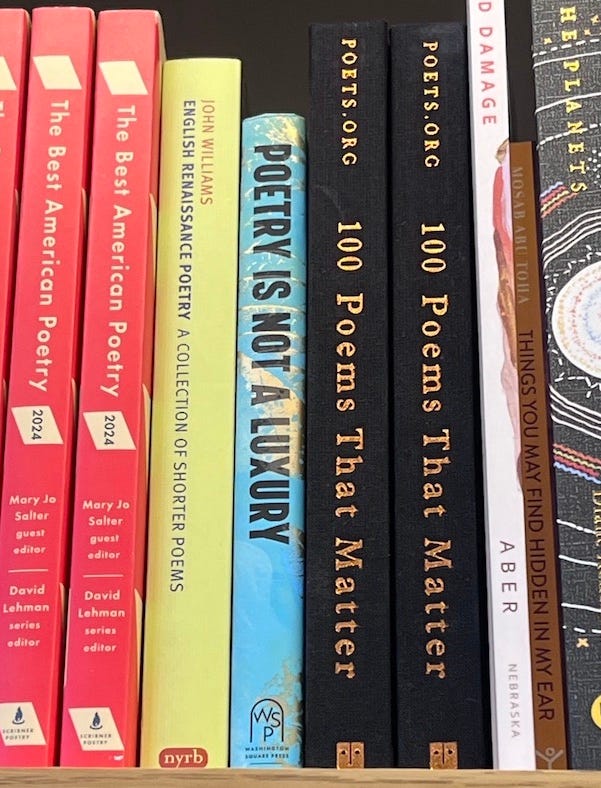
Poetry aspires to be short and not completely irrelevant, or so it seems. It’s hard to say who’s to blame for this. Maybe Auden, with his tragically misinterpreted declaration that “poetry makes nothing happen.” Poetry aspires to something otherworldly, to move something through words that can’t be moved in other ways. But the world instead hears that poetry is fragile and mostly useless. Anne Waldman used to often repeat: “Keep the world safe for poetry.” Poetry must be fundamentally vulnerable, is the rational conclusion. The reader has to be trustworthy. The world could become too violent for this.
It’s hard to imagine how poetry might shift its reputation to something truly powerful, not just to the poet or the one they implicate. Could it ever be something more forceful, more wild? What would this even mean?
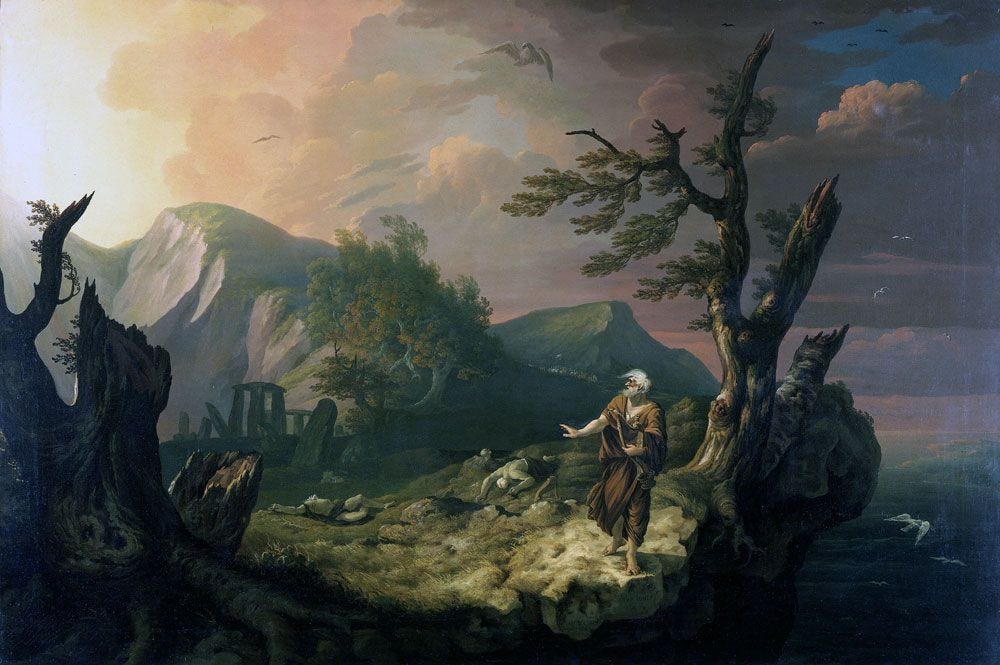
Thomas Gray's ode "The Bard,” from 1757, depicts the last surviving poet under Edward I’s alleged slaughter of the Welsh bards as a figure of power. Shortly before throwing himself over the edge, he stands on a cliff prophesizing the destruction of Edward's line and—more importantly for our purposes—the subsequent dawning of a powerful new literary age:
“The verse adorn again
Fierce War, and faithful Love,
And Truth severe,
Slightly more recently, and more abstractly, Artaud’s Theater of Cruelty was a vision not of direct emotional or physical violence, but theater enacting a violent determination to pierce life in a way we don’t think it capable. Inspired by what he saw as the quasi-religious ability of the Balinese theater to “ extirpate from the mind of the onlooker all idea of pretense, of cheap imitations of reality,” Artaud wanted a bold and ecstatic refusal of distance between the artist and the audience, and between art and consequences in the world, accomplished by presenting the audience with everything they preferred to keep at bay. It’s about as far from today’s poetry shelf as you can get.
The problem is that somewhere along the way, irony got in the way, such that even art that deals with difficult content feels somehow removed from affecting anything. Somehow it all gets relegated to the sphere of the frivolous. Blame it on the Renaissance, with its cacophony of creative activity, necessitating the invention of taste to sort it out. Blame it on Dada, epitomized by Duchamp’s “Fountain,” which by blurring the line between high art and the mundane, equated it with irony from that point on. Blame it on the institution with an inductive bias favoring the predictable drama of wealthy, well-educated New England poets over real linguistic subversion.
We’ve come to accept that artistic expression, literary or otherwise, can only gesture at the mundane or veil our “true perception.” The time for real linguistic innovation has passed, according to the theorists and historians. We can feel nostalgia, but the field is empty and we can’t go back.
The interesting thing is that now we’re experiencing another kind of sterile. Under the spell of language models, prose has become frictionless. The words have come to resemble overchased liquor, reading like floating slowly down a river. There are various ramifications for our relationship with words. I find it more and more difficult to place where an idea came from - was it this essay or something else I read? The same font, the same stream.
Many have argued that against this backdrop, human text, with its imperfections, its “artisanal jagged edges,” becomes more desirable. In theory, perhaps. But the pull for attention of AI-generated text can also make the real stuff feel vaguely fake. The differences between AI-generated and human text in many genres are not that stark, facilitating this transfer.
Still, last month I traveled 1000 miles for a long weekend, primarily for the pleasure of walking into bookstores and finding books that felt worth finding. I was craving the opportunity for real discovery through writing, distilling experiences that could pierce the usual defense mechanisms with which we navigate life. Poetry, with its very different modes of conveying.
Could be more than just nostalgia in this attraction that I, and perhaps others, now feel to language in its more extreme metaphorical forms? Have we already explored all the contours that words can provide? Or could the possibility of something like Artaud’s vision, but for poetry and literature, come closer as a result of AI?
What this means is still a bit vague in my mind. But we could contrast it with what might be the driving fear of the avant garde, which is that even at its extremes, when it’s most intent on subverting linguistic norms, poetry remains at best a kind of balm or therapy for the writer. Personal discovery has appeared often as a theme in recent calls to return to writing: I can’t tell you how many “now more than ever, we have to write for ourselves” style essays I’ve read recently. But writing as self-help is hardly the immediate inescapable force that Artaud envisioned.
The dream of the avant garde, on the other hand, is an intimation of something greater opened to us by the right juxtaposition of words. The possibility that text will shake us awake, compelling us to reject the present glassy-eyed stupor of over-smoothed abstractions, and teach us a radical new way of using words to create the world we want, where creative use of language is integrated with life rather than feebly knocking at the window in the hopes of getting our attention.
The critics have told us that poetry is sterile, but how much is this conundrum fixed? Things have shifted dramatically before, giving rise to new forms of expression. There was, for example, a broadening of artistic forms upon the advent of photography, as Alex Imas describes in his recent essay on what AI might do for art. The possibility of photographic reproduction did not kill painting; it was “quite the opposite.. Art was no longer constrained to reproduce reality—a camera could do it well enough. The realm of the artist was everything that photography could not do.” By this reading, even Van Gogh was just distancing himself from the daguerrotype.
But this took time. It was decades before photography overcame the influence of painting. Many early photographs attempted to reproduce portrait or still life or landscape painting. Smearing Vaseline or scratching the lens to get the effect.
Even Henri Cartier Bresson, who had access to a camera since getting a Box Brownie as a child, didn’t realize its power until 1931, when he encountered a photo taken by Martin Munkácsi of three boys in Tanzania running into a lake.
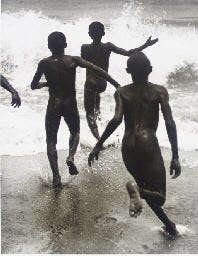
The insight was simple–a photograph “could fix eternity in an instant.” The camera was a “sketch book, an instrument of intuition and spontaneity, the master of the instant which, in visual terms, questions and decides simultaneously.”
Could the abundance of effortless linguistic expression similarly free human writing from its constraining selectivity, to instead swim “in a sea of English with no discipline other than rhythms of exhalation and expostulated statement” as Kerouac envisioned? Could we achieve an immediacy and risk through human writing that hasn’t been possible before? Are we on the verge of using words to slice open new paths?
It does seem striking that experimentation in writing has never sold the way it has in art. It’s made the kind of writing I like eternally hard to find. Even Gertrude Stein, as much name recognition as she might have, is often remembered more as a literary personality who helped cultivate the careers of Hemingway, Picasso, and other notable artists than a profound influence on American literature herself. Most of her writing was “unreadable junk” to critics.
It is not a range of a mountain
Of average of a range of a average mountain
Nor can they of which of which of arrange
To have been not which they which
Can add a mountain to this.
Upper an add it then maintain
That if they were busy so to speak
Add it to and
Perhaps one direction of evolution is that AI increases our appetite for writing that resists easy interpretation, that takes irony and subverting the reader’s expectations to the extreme. Maybe, as so much writing converges to a predictable modal form and tone, people outside the very small experimental poetry community will start to appreciate the unpredictability of the avant garde poetics, the same experiments that I abandoned years ago despite my passion for it out of a desire to do something more “relevant.”
While I like this thought, I also question whether it’s a real possibility. When I reached the language poets in my early twenties, writers who, like Stein, favored a kind of pure play from which meaning had to be constructed by the reader, it felt like I’d come to the end. It was the logical next step in the rejection of tradition’s tight constraint. But by losing the thread of intention, it seemed to expose the impossibility that society we could ever really embrace experimentation and innovation in writing without immediately feeling pulled back by the need for the personality and its messages. As Joanne Kyger said, “The Language school I felt was a kind of an alienating intellectualization of the energies of poetry. It carried it away from the source. It may have been a housecleaning from confessional poetry, but I found it a sterilization of poetry.” Maybe it will never be as easy to appreciate abstract text as it is to appreciate abstract visual forms.
So maybe it’s more realistic to think that AI will push us instead toward a more personal, expressionist version of poetics than has previously seemed possible. As Trish Keenan, who relied on automatic writing for many of the song lyrics she composed for her band Broadcast, puts it:
The repositioned light,
the postatomic night,
Informing me I’m near
the axis of feeling
It seems feasible; after all, it’s precisely the kind of hard-won emotional and physical experience that AI can’t convincingly evoke. Maybe the pull of poetry was always nostalgic, for some direct experience beyond words, but producing the more functional written substrate of our society got in the way of our ability to truly celebrate it. Some have suggested that the abundance of AI-generated art will push everyone to indulge their artistic side, not just those that self-select as artists. A kind of cringey democratization of creative indulgence, like unleashing all the DIY art books in the museum store at once. But this could be interesting too, if it helps popularize a less sterile version of poetry than we currently know, with the kind of immediacy and pure feeling and personal relevance that AI will never fully succeed in reproducing.
Maybe more people will get hurt by words, and we’ll come to see human text as different precisely because of the unique dangers it brings. This would be a far cry from our current fears of AI output and painting of human text as inherently safer. But it’s consistent with believing that human writing is powerful because it deals the reality beyond words, because it aspires to some form of Artaud’s violence.
As expressionist poet Frank O’Hara described a similar realization,
And I see in the flashes
what you have clearly said,
that feelings are our facts.
As yet in me unmade.
Or maybe I’m just looking for some consolation as I watch so many people willingly give up their voice to AI.
Your point about AI possibly democratizing art beyond those who self-identify as artists is really interesting! It reminded me of how social media helped popularize Instagram poets and this new form of poetry that was designed to be easily shareable and digestible (a "born-digital" type of format).
I enjoyed reading your piece in conversation with this older 2019 blog post about Instapoets (https://www.poetryfoundation.org/featured-blogger/81555/instagram-poetry-and-our-poetry-worlds) and thinking about what developments in AI might mean for the appreciation and practice of writing.